

Steaming: how to keep vegetables flavourful, crunchy and beautifully coloured
A pan of boiling water. A handful of broccoli. Wait a moment and it is done.
That is how many of us learnt to prepare vegetables.
But there is another way that is surprisingly simple: steaming.
You don’t put the vegetables in the water, but above it. The hot steam does the work. That way the vegetables cook without lying directly in the cooking water.
The result? A different texture, a lovely colour and often a clearer vegetable flavour.
And perhaps most importantly: steaming isn’t complicated at all.
What is steaming?
With steaming, food is cooked by hot water vapour.
You bring a shallow layer of water to the boil and place the vegetables in a steamer basket, steamer pan or colander above the water. With a lid on, the hot steam stays around the vegetables and cooks the food.
So the vegetables never touch the water.
That is the most important difference from boiling.
Boiling = food cooks in water.
Steaming = food cooks above water, in the steam.
You also don’t need a special steam oven for it. An ordinary pan with a fitting steamer basket works perfectly well. Even a heatproof colander above a pan of boiling water can be used.
Why would you steam vegetables?
Steaming has a few nice advantages.
Because the vegetables aren’t lying in water, they come into less direct contact with water. As a result, flavour and certain nutrients can be retained better than with boiling. The Dutch Nutrition Centre (Voedingscentrum) also names steaming as a cooking method in which more flavour and vitamins can be retained than with boiling.
But there is something else.
Steaming is a gentle way of cooking.
You need no oil or butter and the vegetables become evenly soft without swimming around in a pan of water.
Especially with vegetables where you want to keep tasting the original flavour, that can be pleasant.
Think of broccoli, cauliflower, carrot, green beans or asparagus.
How does a steamer work?
In fact, the system is very simple.
At the bottom there is water.
Above it goes a basket in which the vegetables sit.
On top of that goes a lid.
When the water boils, steam is produced. That warm vapour rises and heats the vegetables.
You can see it as a small sauna for your vegetables.
Except that you don’t have to get in yourself.
How to steam vegetables step by step
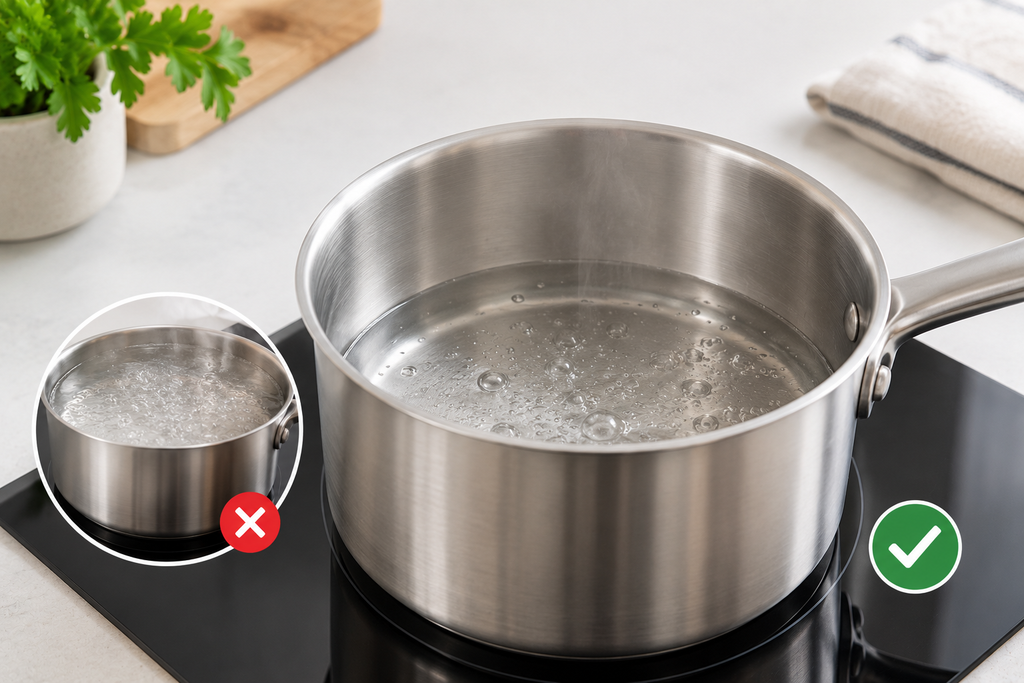
Step 1 – Bring the water to the boil
Put a shallow layer of water in a pan.
You don’t need a full pan. The water must stay below the steamer basket.
Bring the water to the boil before you add the vegetables.
Step 2 – Put the vegetables in the basket
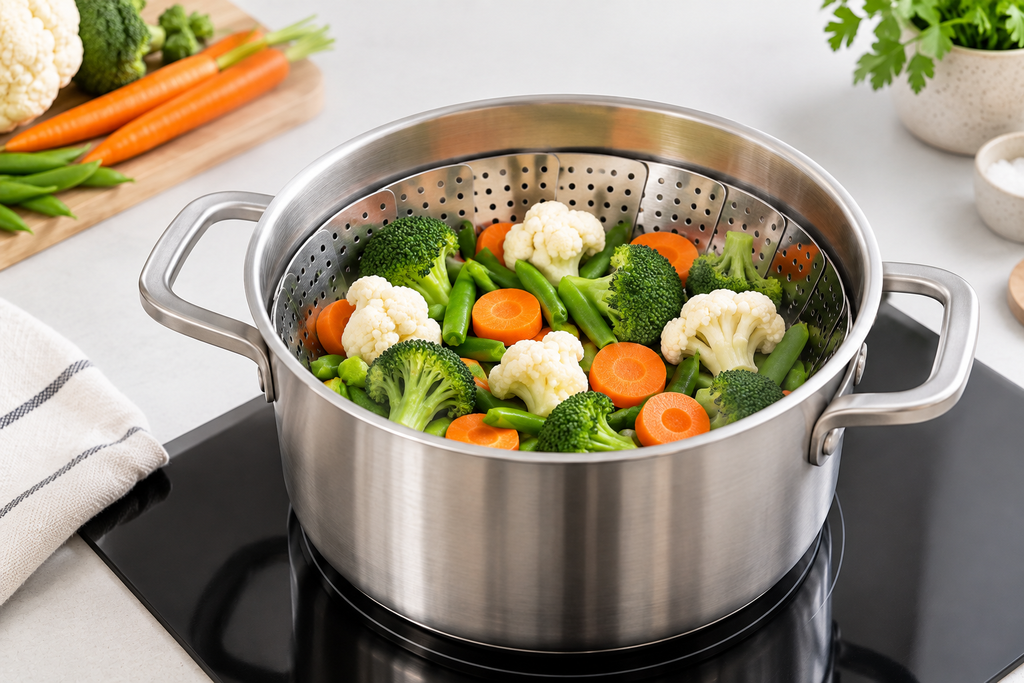
Put the cleaned vegetables in the steamer basket.
Make sure they aren’t all crammed on top of each other.
A little space helps the steam to get everywhere.
Step 3 – Put the lid on the pan
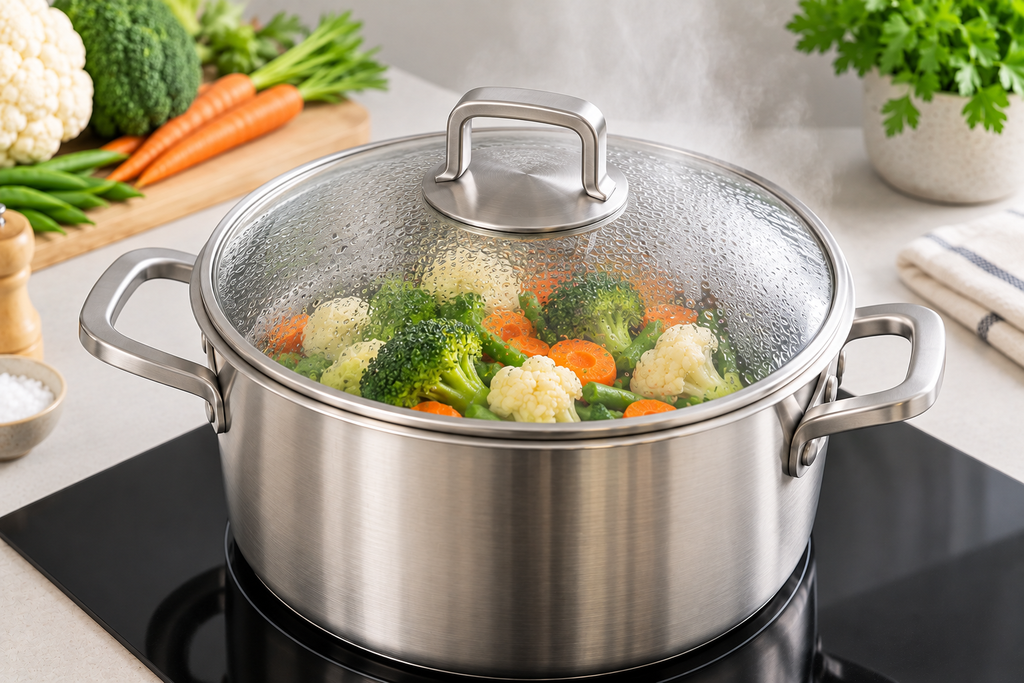
Put the lid on the pan.
This keeps the steam around the vegetables so it can do its work.
Is a lot of steam escaping from under the lid? Then turn the heat down a little.
The water needs to keep steaming, but doesn’t need to boil like mad.

Step 4 – Let the vegetables cook
Now it is mainly a matter of waiting and checking.
The exact time depends on the vegetable and the size of the pieces.
Small pieces cook faster than large pieces.
How do you know if steamed vegetables are done?
This is more important than an exact cooking time.
A recipe may say that broccoli, for example, needs a certain time, but your florets may be larger or smaller.
So after a few minutes, prick the vegetable with a fork.
The fork should go in easily, but the vegetable doesn’t need to fall apart.
For many vegetables, al dente is a good starting point.
That means:
soft enough to be pleasant to eat, but still with a slight bite.
Especially with vegetables, that is often nicer than cooking them completely soft.
Al dente: what does that actually mean?
You come across the word regularly in recipes.
But what exactly do you feel?
An al dente vegetable is neither hard nor limp.
You can bite into it without needing force, but you still feel a slight resistance.
Think of a green bean that is still firm and doesn’t fall apart limply.
Or broccoli whose stalk is soft enough to eat, but still clearly has structure.
Al dente is not an exact temperature or time. It is mainly a matter of texture.
And that is exactly why tasting is so important.
Which vegetables can you steam?
Very many vegetables lend themselves to it.
| Vegetable | What happens when steamed? | What to watch for |
|---|---|---|
| Broccoli | Soft and fresh in flavour | Stalk and florets cooked at the same time |
| Cauliflower | Soft but firm | Don’t steam for too long |
| Carrot | Sweet and soft | Cut into equal pieces |
| Green beans | Firm and crunchy | Don’t let them go limp |
| Asparagus | Soft and delicate | Thickness determines the time |
| Courgette | Quickly soft | Steam briefly |
| Brussels sprouts | Softer and less hard | Halve large sprouts |
| Peas | Soft and sweet | Short cooking time |
| Pak choi | Soft with firm parts | Stalks need more time |
The size of the pieces makes a big difference.
A whole carrot, for example, needs considerably more time than a carrot cut into slices.
So cut vegetables deliberately
Want to steam different vegetables at the same time?
Then don’t just look at the type of vegetable, but also at the size.
A large carrot and a small piece of broccoli don’t have the same cooking time.
You can solve this by cutting the firmer vegetables smaller or by putting them in the steamer earlier.
That way different vegetables can still be cooked together.
It isn’t only the vegetable that determines the cooking time. The size of the piece counts too.
Why do my vegetables go limp?
That is probably the most common complaint about steaming.
You wanted lovely al dente broccoli.
You got green mush.
Usually the answer is simple:
steamed for too long.
Steaming is not a method where you can leave the vegetables alone for a quarter of an hour.
As soon as the vegetables are cooked, they are done.
So take them out of the pan in time.
Soft vegetables such as courgette in particular can quickly become overcooked.
Why do my vegetables get watery?
Steamed vegetables can feel a little moist at the end.
That is normal.
But if they really become watery, that can be because they were steamed for too long or because a lot of condensation ends up on the vegetables.
After steaming, if necessary, let excess moisture evaporate for a moment before you serve the vegetables.
And don’t use more water than necessary.
The food should stay above the water.
Steaming is not the same as boiling
That difference may seem small, but you notice it on your plate.
With boiling, the vegetable lies directly in hot water.
With steaming, the vegetable lies above it and the heat comes via the vapour.
With boiling, water-soluble nutrients can end up partly in the cooking water. The Nutrition Centre states that vegetables can lose 20 to 50% of their vitamins when boiled and that more vitamins can be retained with steaming.
That doesn’t mean, incidentally, that boiling is bad.
Boiling is a perfectly good cooking method.
It mainly means that the cooking method influences the final result.
And that is exactly why it is interesting to learn different techniques.
How do you keep the colour nice?
Well-steamed broccoli can stay a beautiful green.
The cooking time and not letting it overcook play the biggest part in that.
So don’t leave vegetables in the steam longer than necessary.
Take them out as soon as they have the texture you want.
If you want to stop the cooking immediately, you can briefly cool some vegetables after steaming. That is especially handy when you want to use them in something else later, for example in a salad.
Should you add salt to the water?
You don’t need to.
Because the vegetables aren’t in the water, salt in the steaming water has little effect on the flavour of the vegetables.
It is therefore usually more practical to season the vegetables after steaming.
A little salt, pepper, olive oil, butter, lemon or herbs can then make much more difference.
Steamed doesn’t mean tasteless
Sometimes steaming has the image of healthy but boring food.
It doesn’t have to be at all.
The trick is in what you do after steaming.
A few examples:
Broccoli
Lemon juice, black pepper and a little olive oil.
Carrot
A little butter, parsley and black pepper.
Cauliflower
Olive oil, nutmeg or a little curry powder.
Asparagus
Butter, lemon and fresh herbs.
Green beans
Olive oil, garlic and toasted almonds.
So steaming is mainly the way you cook the vegetable.
After that, the seasoning begins.
When do you add herbs?
That depends on what you use.
You can add dried herbs before steaming if you like, but many fresh herbs come into their own better when you use them afterwards.
Think of:
- parsley;
- chives;
- dill;
- basil;
- coriander.
Lemon is also a lovely combination with steamed vegetables.
A little acidity can bring out the flavour of vegetables more clearly.
Can you steam several vegetables at once?
Yes, but think carefully about the cooking time.
You can, for example, cook carrot and broccoli together, but it can be handy to cut the carrot a little smaller.
Another option is to steam the carrot for a few minutes first and then add the broccoli.
That way both vegetables are cooked at about the same time when they reach the table.
That is a simple cooking technique that you get better at the more often you cook.
What do you need?
You really need very little.
The simplest set-up
- a pan with a lid;
- a steamer basket;
- water;
- vegetables.
Don’t have a steamer basket?
A heatproof colander can work too, as long as it sits firmly above the pan and doesn’t touch the water. The Nutrition Centre also names this method as a possibility.
A special steam oven is therefore absolutely not necessary.
A handy beginner’s test
Want to experience the difference for yourself?
Take a head of broccoli.
Divide it into roughly equal florets.
Steam one part until al dente.
Boil another part in water.
Taste both side by side.
Pay attention not only to the flavour, but also to:
- colour;
- texture;
- firmness;
- moistness;
- smell.
That way you discover much faster what different cooking methods do to the same ingredient.
And that is exactly where cooking gets interesting.
The five rules for good steaming
1. Don’t use too much water
The vegetables must not touch the water.
2. Keep the lid on
That keeps the steam in the pan.
3. Cut equal pieces
That prevents some pieces from being soft while others are still hard.
4. Check in good time
A few minutes too long can make the difference between al dente and limp.
5. Only then season well
Salt, pepper, herbs, butter, oil or lemon turn steamed vegetables into a complete dish.
And then you discover why steaming is so handy
Steaming is perhaps one of the simplest cooking techniques.
Not much spectacular happens in the pan. No sizzling butter, no spitting oil and no complicated sauce.
You put water in a pan, put the vegetables above it and let the steam do its work.
But that is exactly where the strength lies.
You learn to look at colour, texture, size and doneness. You learn that a carrot doesn’t automatically need the same time as broccoli. And you discover that vegetables don’t have to be soft and watery to be cooked.
The next time you prepare broccoli, carrot, cauliflower or green beans, try steaming them.
Not for too long.
Not too much water.
And above all: taste along the way.
Because once you learn to recognise when a vegetable is exactly right, you haven’t just learnt steaming as a trick, but as a real cooking technique.